
Most businesses think they have an inventory problem.
In reality, inventory is rarely the problem. It's the consequence of uncertainty.
Every pallet, carton or component sitting in a warehouse exists because a business is protecting itself against something it cannot predict with complete confidence. The more uncertainty a business faces, the more inventory it generally needs to maintain customer service.
The real opportunity isn't simply to reduce inventory. It's to reduce the uncertainty that makes inventory necessary in the first place.
This shift in thinking changes how inventory should be managed. Instead of asking "How do we reduce inventory?", businesses should be asking "What uncertainty are we protecting ourselves against?"
That is where meaningful inventory improvement begins.
Why Businesses Hold Inventory
No business deliberately invests in inventory without a reason.
Inventory exists to absorb the uncertainty between supply and demand. It protects businesses when customer demand fluctuates, suppliers deliver late, production schedules change or transport networks are disrupted.
Without inventory, even relatively small disruptions could result in stockouts, missed deliveries and dissatisfied customers.
Inventory provides resilience. The challenge is that resilience comes at a cost.
The Hidden Cost of Uncertainty
Every additional unit of inventory represents capital that could be invested elsewhere in the business.
Holding inventory carries costs well beyond the purchase price, including storage, handling, insurance, obsolescence and the working capital tied up in stock.
Higher inventory levels typically result in:
- More working capital tied up in stock
- Increased storage and handling costs
- Greater risk of damage, obsolescence or expiry
- Lower inventory turnover
- Reduced return on assets
On the other hand, carrying too little inventory creates a different set of problems:
- Stockouts and lost sales
- Expediting costs and reactive freight
- Production interruptions
- Reduced customer satisfaction
Finding the right balance has never been about holding as little inventory as possible. It has always been about holding the right amount for the level of uncertainty your business faces.
Inventory Is a Buffer Against Uncertainty
One of the simplest ways to think about inventory is as a buffer.
When uncertainty increases, businesses increase the size of that buffer. When uncertainty decreases, the buffer can safely become smaller.
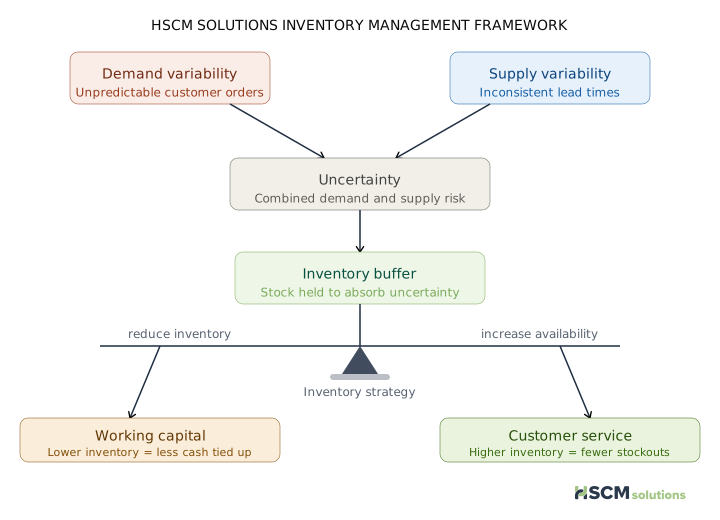
The objective isn't to minimise inventory. It's to achieve the right balance between working capital and customer service for the level of uncertainty the business faces.
This is why two businesses selling similar products can operate with very different inventory levels.
A business with stable demand, reliable suppliers and predictable lead times can often hold significantly less inventory than another facing constant variability.
The difference isn't better inventory management. It's lower uncertainty.
Where Uncertainty Comes From
Most inventory uncertainty falls into two broad categories.
Demand uncertainty is the difference between what customers actually order and what the business expected. Sales promotions, seasonal fluctuations, changing customer preferences and unexpected market events all influence demand. The less predictable demand becomes, the larger the inventory buffer generally needs to be.
Supply uncertainty is the variability in how long it takes for inventory to arrive after an order has been placed. Supplier performance, manufacturing delays, shipping disruptions, customs clearance and inconsistent lead times all increase supply uncertainty. Every additional day of uncertainty increases the amount of inventory required to maintain customer service.
Understanding these two sources of variability is the first step towards building a more efficient inventory strategy.
Reducing Inventory Starts Long Before the Warehouse
Many businesses attempt to reduce inventory by changing reorder points or simply purchasing less.
While these actions may temporarily lower stock levels, they rarely address the underlying causes.
Sustainable inventory reduction rarely starts with inventory itself. It starts by improving the systems that create certainty:
- Improving forecast accuracy
- Strengthening supplier relationships and reliability
- Reducing lead times
- Reviewing replenishment parameters regularly
- Improving communication between sales, operations and procurement
When these areas improve, inventory often reduces naturally because less protection is required.
A Practical Example
One of the most rewarding inventory projects I have been involved in wasn't about aggressively cutting stock.
It began by questioning the assumptions behind the inventory settings.
The organisation had experienced significant changes in demand over time, yet many of its planning parameters had remained unchanged. Inventory policies were still protecting against a level of uncertainty that no longer existed.
By reviewing those assumptions and aligning inventory settings with the current demand profile, the organisation reduced inventory by more than 30% while continuing to meet operational requirements.
The improvement didn't come from taking more risk or simply cutting stock. It came from recognising that the business had become more predictable while its inventory policies had remained unchanged.
Ask Different Questions
Businesses often ask: "How can we reduce inventory?"
A more valuable question is: "What uncertainty are we protecting ourselves against, and is that still the right amount?"
That shift in thinking changes the conversation completely.
Instead of focusing solely on stock levels, businesses begin improving forecasting, supplier performance, replenishment strategies and operational processes. Inventory then becomes the outcome of better planning rather than the objective itself.
If inventory hasn't been reviewed recently through this lens, a few questions are worth asking:
- Are our inventory parameters still aligned with today's demand profile?
- Where is demand or supply creating the greatest uncertainty?
- Which suppliers allow us to safely reduce inventory, and which require more protection?
- If forecast accuracy improved, how much working capital could we release?
These questions don't require a new system. They require visibility, good data and a willingness to challenge long-standing assumptions.
Final Thoughts
Businesses that focus only on reducing inventory often find it returns.
Businesses that reduce uncertainty usually find inventory follows.
High-performing supply chains don't succeed because they hold less inventory. They succeed because they operate with less uncertainty.
When demand becomes more predictable, suppliers become more reliable and operational processes become more consistent, inventory naturally follows.
That's why the best inventory strategies don't begin in the warehouse. They begin by reducing uncertainty across the supply chain.
Inventory is the consequence. Uncertainty is the cause. The businesses that manage inventory best are rarely the ones focused on stock. They're the ones focused on reducing uncertainty.
How to determine the right amount of buffer stock using demand variability, lead time variability and service level targets.