
In Part 1 of this series, we established that inventory exists because of uncertainty.
The more unpredictable demand becomes, and the more variable supply becomes, the more inventory a business generally needs to maintain customer service.
Safety stock is the mechanism that absorbs that uncertainty.
But in most businesses, safety stock isn't calculated. It's inherited. A fixed number of weeks carried forward from a previous planner. A buffer added after a stockout. A policy nobody has reviewed because nothing has gone dramatically wrong.
Safety stock isn't extra inventory. It's the price of uncertainty. And like any cost, it should be understood, measured and managed deliberately.
Why Averages Aren't Enough
Most inventory systems are built around average demand.
Average weekly sales. Average lead time. Average order quantity.
Averages are useful. But they hide something important.
Consider two products with identical average weekly demand of 100 units.
Product A sells between 95 and 105 units every week. Demand is stable and predictable.
Product B sells anywhere between 40 and 160 units depending on the week. Demand is highly variable.
Both products have the same average. But Product B requires significantly more safety stock to maintain the same service level, because the range of possible outcomes is much wider.
Inventory planners often measure this variability using standard deviation. It doesn't measure the average outcome. It measures how widely actual demand varies around that average.
A product with low standard deviation has predictable demand. A product with high standard deviation has variable demand. And variable demand requires more safety stock to protect against the unexpected.
This is why setting safety stock based on averages alone, or applying a fixed number of weeks uniformly across the range, produces the wrong result for most products. Some will be overstocked. Others will be exposed.
What Drives Safety Stock
In Part 1, we introduced two sources of uncertainty: demand uncertainty and supply uncertainty.
Safety stock is calculated by measuring both sources of uncertainty, together with the service level the business wants to achieve.
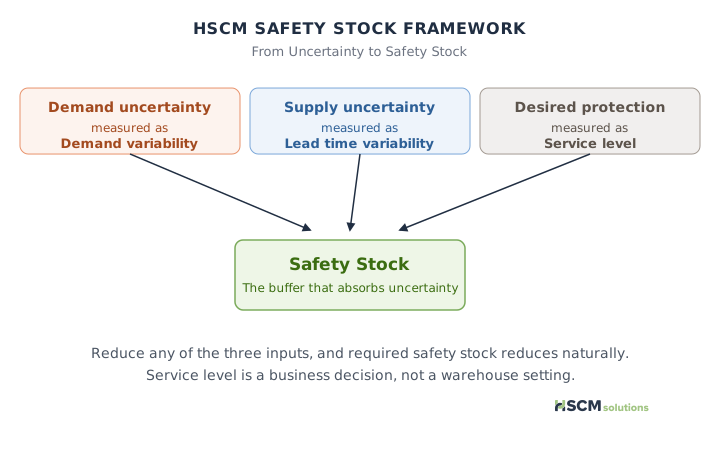
Reduce any of the three inputs, and required safety stock reduces naturally. Service level is a business decision, not a warehouse setting.
Demand variability is the measurable equivalent of demand uncertainty. It quantifies how widely actual customer orders vary around the forecast. The wider the spread, the more buffer is needed to protect against demand being higher than expected.
Lead time variability is the measurable equivalent of supply uncertainty. It quantifies how consistently suppliers deliver within their quoted lead time. A supplier that consistently delivers in four weeks creates a predictable replenishment window. A supplier whose lead time ranges from two to eight weeks creates a much wider window of exposure, and requires significantly more safety stock to cover it.
Service level is the commercial decision that determines how much protection the business wants to achieve. A 95% service level means the business can fulfil customer orders from available stock 95% of the time. A 99% service level means 99% of the time.
Improve any of these three inputs and the required safety stock changes. Reduce uncertainty or lower the desired service level, and the inventory buffer can reduce naturally.
That's why the most effective inventory improvements often start with the question: which of these three inputs can we improve?
The Safety Stock Formula
Several safety stock formulas exist depending on the data available and the sophistication of the planning system.
More advanced calculations incorporate both demand variability and lead time variability simultaneously. The underlying principle remains exactly the same: higher uncertainty requires a larger safety stock.
In its simplest form:
- Weekly demand: 100 units
- Standard deviation of demand: 15 units
- Average lead time: 4 weeks
- Service level: 95% (Z = 1.65)
Now imagine forecast accuracy improves and the standard deviation falls from 15 units to 10 units:
The formula isn't the important part. Understanding what drives each variable is.
A higher Z means more protection, and more inventory investment. Higher demand variability means more uncertainty, and more inventory required. Longer or more variable lead times mean a wider window of exposure, and more inventory required.
Reduce any of these and safety stock reduces naturally.
Service Level Is a Commercial Decision
Here is where most inventory conversations go wrong.
Service level is treated as a warehouse metric. A target set by operations. A number that gets reported on a dashboard.
But the service level decision isn't made in the warehouse. It's made by the business.
When a business decides it wants to fulfil 99% of orders from available stock, it is making a commercial decision that the cost of a stockout is high enough to justify the additional inventory investment required to achieve that level of protection.
When a business decides that 90% is acceptable for a slow-moving product, it is making a different commercial decision that the carrying cost of the additional inventory outweighs the risk of an occasional stockout.
Safety stock is a commercial decision disguised as a mathematical calculation.
The formula determines how much inventory is needed to achieve a given service level. The business decides what service level to target, and therefore how much inventory it is willing to invest.
| Service level | Z factor |
|---|---|
| 90% | 1.28 |
| 95% | 1.65 |
| 97% | 1.88 |
| 99% | 2.33 |
| 99.9% | 3.09 |
Higher service levels improve product availability, but every increase comes with an additional inventory investment. That trade-off is a business decision, not a planning decision.
Not every product should have the same service level. We'll explore how to set different service levels by product category in Part 3.
The Most Common Safety Stock Mistakes
- Setting safety stock as a fixed number of weeks. Four weeks of cover for every product regardless of demand variability, lead time or commercial importance. This produces the wrong result for almost every product in the range.
- Never reviewing it. Safety stock set for last year's demand profile, last year's supplier performance and last year's service requirements. The business changes. The safety stock doesn't.
- Applying the same service level to every SKU. A critical high-value product that drives significant revenue deserves a higher service level than a slow-moving low-margin item. Treating them the same ties up working capital on products that don't justify the investment.
- Confusing safety stock with cycle stock. Safety stock protects against variability. Cycle stock is the inventory that depletes and is replenished through normal ordering. They serve different purposes and should be sized differently.
Questions Worth Asking
If safety stock hasn't been reviewed recently, a few questions are worth considering:
- Which products carry the most demand variability, and is that reflected in their safety stock settings?
- Which suppliers have the most variable lead times, and are those products carrying enough buffer?
- Are service level targets set deliberately by product category, or applied uniformly across the range?
- When were safety stock parameters last reviewed against current demand and lead time data?
- Are there products where safety stock has grown over time without a clear operational justification?
These questions don't require sophisticated software. They require visibility of the data that already exists, and the discipline to review it regularly.
The Connection to Part 3
Calculating safety stock correctly is only part of the challenge.
The next question is whether every product in the range deserves the same service level, the same replenishment frequency, and the same level of management attention.
Most don't.
In Part 3 of this series, we'll explore how ABC classification, reorder points, and inventory control practices should differ across the product range, and why treating every SKU the same is one of the most expensive habits in inventory management.
Safety stock isn't about preparing for everything that might happen. It's about deliberately deciding how much uncertainty your business is prepared to absorb.
The calculation provides the answer. The business decides the question.
Part 3: ABC classification, service levels by segment, reorder points, and why inventory policy should differ across the product range.